Pan’s Guest
Editura Școala Ardeleană, November 2026
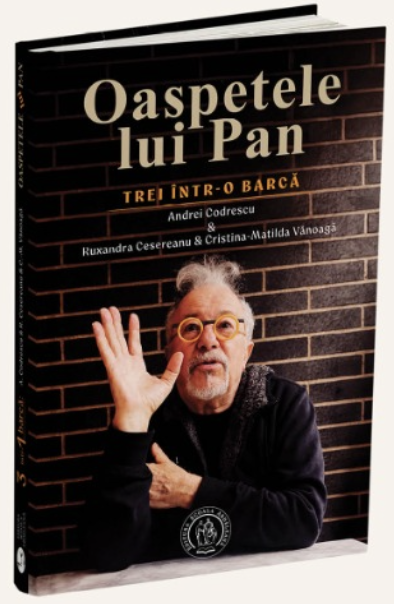
photo John Sarsgard
Pan’s Guest: an appreciation by Ruxandra-Mihaela Cesereanu & Cristina Matilda Vanoaga. Romanian
oaspetele lui pan
a paean to the cheeky
oaspetele lui pan, published by Editura Școala Ardeleană November 2026
Release date November, 2026
ISBN:
AI translation of introductiont by Claudiu Komartin
Andrei Codrescu is one of those rare poets who, when you read them and surrender yourself to their keeping, energize you, stir up pleasurable unrest, prick you, bring unexpected euphorias. Immersed in the great Codrescian poem, you feel compelled to read more, and in every direction from which you sense his writing draws its sustenance; to become a persistent rummager through books; to seek what he himself has sought; to write yourself, entering into dialogue with his text, extending it or weaving a tapestry in which, if you look closely enough, you can discover ancient signs, veiled meanings, biographical traces of someone who seems to have lived at least three lives, distant echoes of a time when the poet was still a sorcerer, a shaman, a cunning bloodhound of the transcendent.
It was far from easy to arrive at a satisfactory approach to putting this anthology together. Andrei was founding the legendary publication Exquisite Corpse: A Journal of Letters and Life before I was born. I don’t hold that against him. Something makes me think that, if the transmigration of souls really exists, it takes place in every direction, toward the future and equally toward the past, so perhaps I too will have the chance to meet Codrescu’s great New York friends, whom I have known only through books.
The anthology the ripe fruits of babel, then, offers a personal selection from an admirable body of poetry: more than twenty volumes published between 1968 and 2025, alongside another thirty books of essays, memoirs, stories, and novels, many of which have been translated and published in Romanian. I have been reading Codrescu since the beginning of the century, and Selected Poetry / Poezii alese (2000, superbly translated by Ioana Ieronim), through which I first encountered his writing, has remained an important book in my library. A decade ago it was joined by Arta uitării / The Art of Forgetting, translated by Alexandru Opescu. Since then, Andrei has published several more books that are balm for a wound: No Time Like Now (2019), Too Late for Nightmares (2022), How to Live Under Fascism(2025). The poems I have chosen from these three volumes make up almost half of the present anthology.
Codrescu’s poetry, infused with the spirit of Dada and surrealism, encountered the ferment of the New York poetry scene at just the right moment: the late 1960s, when he emigrated to the United States. His is the poetry of a vitriolic post-avant-gardist—as is so evident in his debut volume, Licence to Carry a Gun, and in those that followed in the 1970s, from The History of the Growth of Heaven to Necrocorrida—whose defining traits—absurdity, the mocking guffaw of the Cabaret Voltaire, nonconformism, the exile’s dilemmas of identity—formed a sparkling alloy with pop art and the counterculture of perhaps the most fertile artistic period in American history.
I am immensely happy to welcome Andrei back with these seventy-odd poems, especially since his return is taking place at Casa de Editură Max Blecher, for which the tradition represented by Tzara, Fundoianu, and Gherasim Luca means so much.